IATA Cat Travel Crates for Cargo & Long-Haul: Sizes, Setup & Top Picks (2025)
If cargo travel feels scary, this guide gives you the support you need: when cargo is appropriate, which crate size fits your cat, how to set it up, and what the journey actually looks like from check-in to arrival.

Last updated: 1 December 2025
Quick size guide: which crate series usually fits?
| Start here | Your cat | Typical body length* (nose → base of tail) | Series band |
|---|---|---|---|
| Check Sky Kennel 100 → | Petite (≈ 3–4 kg) | Up to ~45 cm | Series 100 (small) |
| Check Sky Kennel 200 → | Average adult (≈ 4–6 kg) | ~45–58 cm | Series 200 (medium) |
| Check Sky Kennel 300 → | Larger / tall (≈ 6–7.5 kg) | ~58–68 cm | Series 300 (intermediate) |
| Check BEETZEES Skykennel N.4 → | Very large / Maine Coon–type (8 kg+) | Over ~68 cm | Series 400 (large “small dog” size) |
*These are real-world ranges, not exam marks. Always measure your cat’s standing height as well. If their ears touch the roof of a smaller crate, you must size up, even if their weight fits the lower band. Your airline’s cargo team has the final say, so always confirm their crate requirements before you book.
Not sure what to read next?
• Is cargo fair for your cat? Jump to “Should your cat go in cargo?”
• Just need crate sizing help? Go to “Sizing the crate: measurements & choosing a size band.”
• Crate bought and want to make the journey kind? Skip to “Interior setup: what goes inside (and what doesn’t)” and “Day of travel: what actually happens.”
Below, we slow things down. We’ll walk through:
- When cargo is (and isn’t) a fair option
- How to measure your cat properly
- How to sanity-check that size band
- How to set the crate up so it feels like a den rather than a box
- What the day of travel really looks like from your cat’s point of view
Not sure if cabin is still an option? If your cat is smaller and your route is short and simple, cabin in a soft carrier may still be kinder. You can check that path and airline-approved carriers here first:
1. Before Anything Else: Should Your Cat Go in Cargo?
Before you look at crate sizes and product pages, it’s worth taking a breath and asking the key question:
“Is cargo genuinely the right way for this cat, on this route, right now?”
1.1 When cabin is clearly wrong
Cargo often becomes the better option when:
- Your cat simply can’t fit in a cabin-sized carrier within airline limits and still:
- Stand up naturally
- Turn around
- Lie down without being squashed
- Your route is 10–14+ hours door to door, with tight cabins and multiple legs, and there’s no realistic way to:
- Break it into comfortable chunks, or
- Use a pet-friendly train/ferry alternative
- Climate or airline rules block cabin, but allow properly handled cargo:
- Some airlines only accept pets as manifest cargo on certain long-haul routes
- Some limit cabin pets by cabin or aircraft type but have established cargo processes
In those situations, a larger, stable crate in a controlled hold can be kinder than forcing a big cat into a cramped under-seat space for half a day.
1.2 When cargo is often kinder
Cargo, done properly, can be the better choice for:
- Big, solid cats in good health who can stand, stretch and turn easily in a dog-sized crate
- Cats travelling long-haul on predictable, well-timed journeys with:
- One non-stop or single-stop flight
- Thoughtful routing around extreme heat or cold
Inside a correctly sized IATA-style crate (more on IATA in Section 2), your cat has:
- Room to change position
- Consistent bedding and scent
- Darkness and steady background noise once in the hold
It’s not quite a leisure day, but it can be a stable, manageable experience rather than a gamble.
1.3 When cargo may not be a good idea
There are also cases where cargo is genuinely questionable. Without offering medical advice, common red flags include:
- Very fragile health or unmanaged heart / respiratory disease
- Brachycephalic (flat-faced) breeds with breathing compromise
- Extreme age or frailty
- Cats who are already struggling to cope in everyday life at home
In those situations, the most cat-centred options are often:
- Delay the move until health is stable
- Explore alternative routes (ground transport, ferries, different timing)
- Reconsider whether this particular relocation is fair to them
A quick thought to keep in mind:
If you’re in the big-cat / long-haul bucket, your vet is broadly on board, and you’re prepared to plan around route and climate, the goal is not to avoid cargo at all costs, but to set it up so your cat gets a predictable, stable environment for the whole journey.
2. IATA Basics: What “IATA-Approved” Really Means
“IATA-approved” gets thrown around a lot on product pages, often as a marketing label. Underneath that, there are real standards.
2.1 What IATA is actually doing here
IATA (the International Air Transport Association) publishes guidelines for live animal containers. Airlines then adapt those guidelines into their own cargo rules.
You can refer to the image below to get a sense of the key criteria:
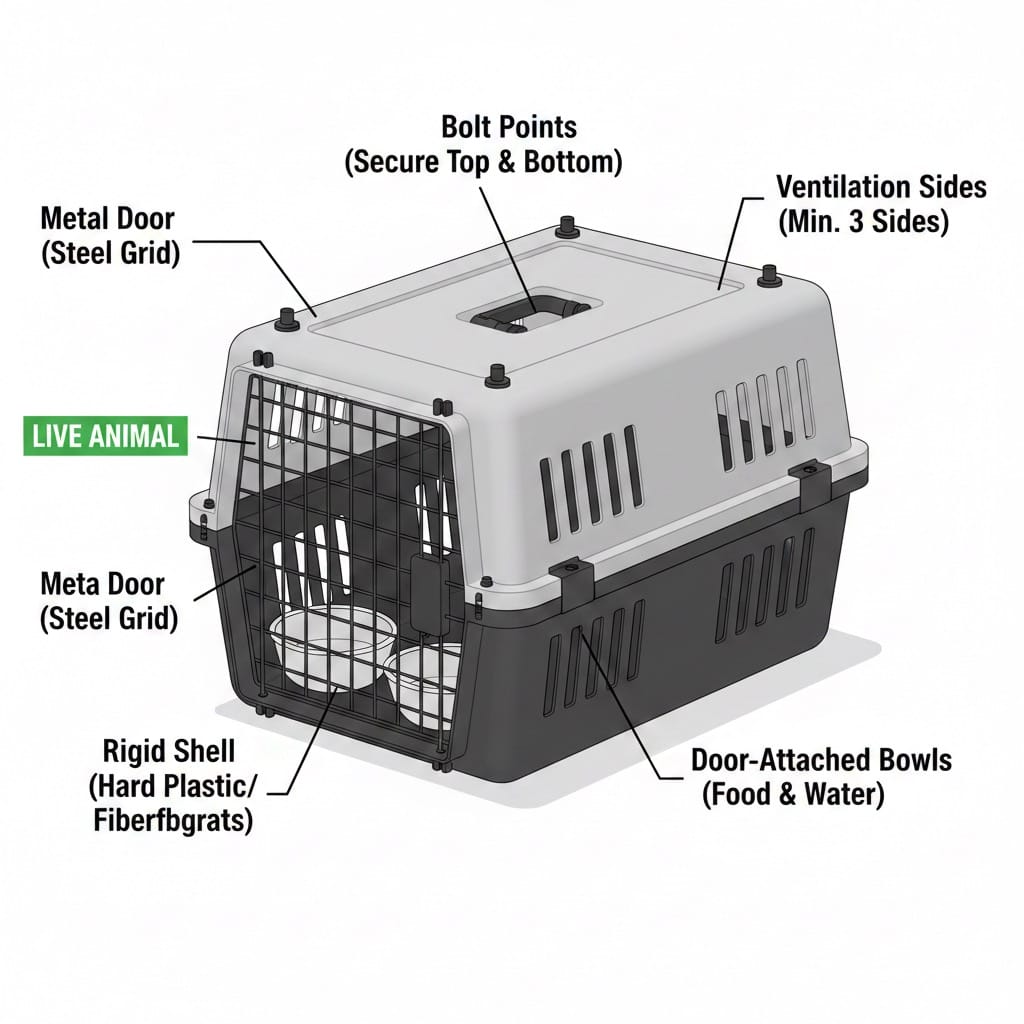
They care about things like:
- Structure: a rigid shell that won’t collapse if it’s bumped or stacked
- Door: strong metal door with a secure latch
- Ventilation: adequate airflow on at least three sides (often four)
- Floor: no large gaps, stable base that won’t flex under weight
- Fasteners: top and bottom halves fixed with bolts, not just a few plastic clips
- Handling points: areas where staff can safely grip or strap the crate
Many airline cargo pages boil this down to:
- Hard plastic or fibreglass crate
- Metal door that can be cable-tied
- Enough headroom for the animal to stand naturally
- Food/water bowls attached to the inside of the door
- Space to stand, turn and lie down comfortably
2.2 Why “IATA-approved” on the label isn’t the last word
A crate can say “IATA approved” in big letters and still be rejected if:
- It has a flimsy clip-only closure
- The plastic is cracked, brittle, or clearly worn
- It doesn’t match your airline’s specific animal travel conditions
The practical rule is:
Your airline’s cargo team has the final say. You work to their written standards, not just the word “IATA” on the box.
In practice, that means:
- Always checking your airline’s pet cargo page
- Matching what you buy to their description of acceptable crates
- Being ready for a quick crate inspection at check-in
3. Sizing the Crate: Measurements & Choosing a Size Band
A crate can be structurally perfect and still be wrong if it’s the wrong size.
You’re aiming for a den: enough space to move and settle, not so much space that they slide around endlessly.
To get there, you need two measurements:
- Your cat’s body measurements
- The crate’s usable internal space
3.1 Measure your cat (length, height, weight)
It’s easiest to do this when your cat is calm and on a flat surface.
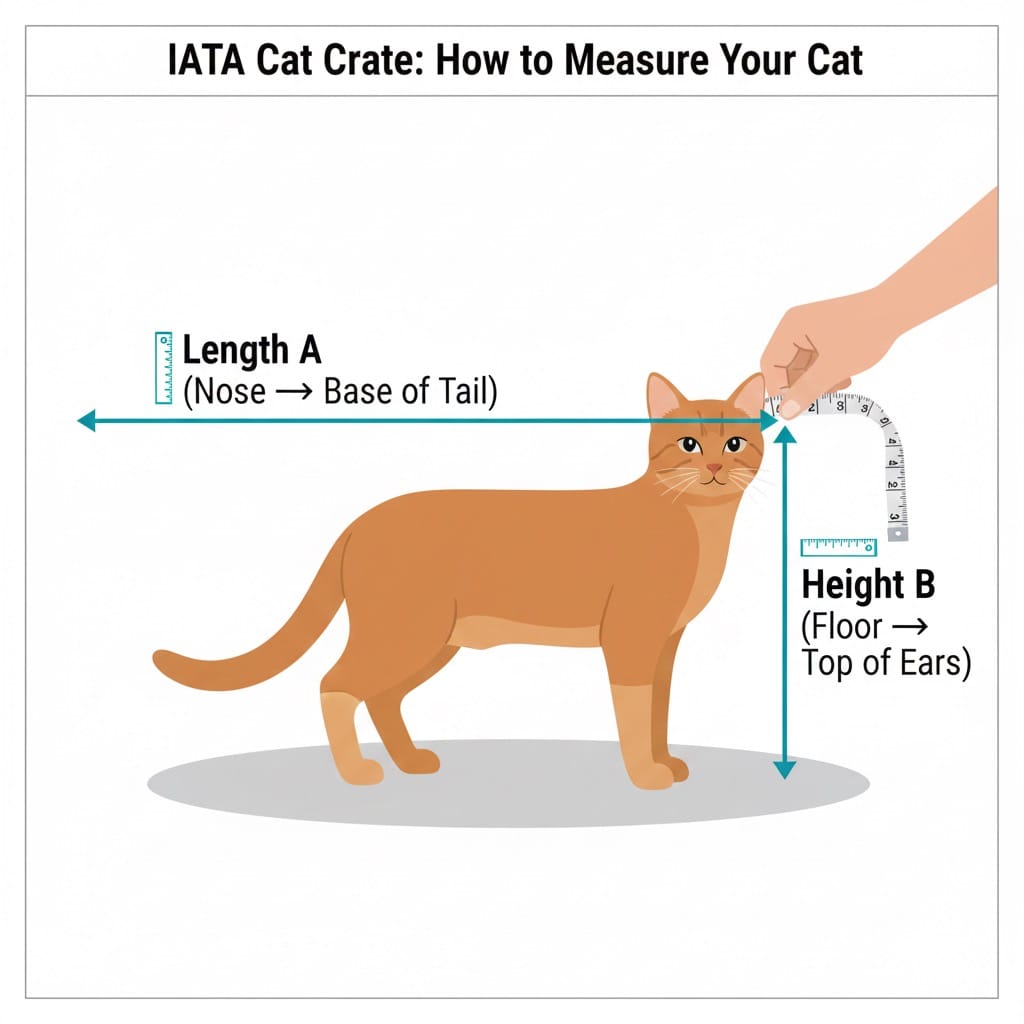
You’re looking for three simple numbers:
- Length: nose to base of tail
- When they’re standing naturally or gently stretched, not fully “yoga-cat” elongated
- Standing height: floor to top of head or ears
- Take this when they are standing in a relaxed way, not crouching
- Weight:
- Useful for both crate choice and airline limits (cat + crate total)
You don’t need millimetre-perfect precision. You just want a good sense of whether you have:
- A petite 3–4 kg cat
- A typical 4–6 kg adult
- A solid 6–8 kg unit
- A genuine “small dog in cat form”
3.2 How those numbers map to crate space
Most airlines phrase it like this:
- The animal must be able to stand up naturally,
- Turn around, and
- Lie down in a normal position without being pressed against the sides.
Translated into crate reality, that means:
- Internal length should be comfortably longer than your cat’s body length, so they can lie on their side without their nose and rump touching both ends at once.
- Internal height should be higher than their standing height, so they don’t have to duck or tilt their head just to stand.
- Width should allow them to lie with their legs tucked or slightly outstretched without their body being wedged between side walls.
Two important cautions:
- Don’t choose a size that looks “cute and snug” in photos but forces your cat to curl tightly all the time. For a long-haul journey, that gets tiring quickly.
- Don’t rely on a giant bed to pad out a too-large crate. Thick beds can steal headroom and reduce usable floor space.
As a rule of thumb:
If you’re hesitating between two sizes and both meet your airline’s maximums, lean towards the larger one for long-haul — as long as your cat still feels contained rather than rattling around.
3.3 Choosing a size band, not one magic number
Different manufacturers use different labels, but most hard crates fall into familiar bands often described as:
- Small / “100”
- Medium / “200”
- Intermediate / “300”
- Large / “400” (and above)
And when you’re looking at them online or in-store:
- Compare the internal dimensions (if given) to your cat’s measurements plus some margin.
- If only external dimensions are listed, allow for the shell thickness and hardware — internal space will be slightly smaller.
- Cross-check that the crate is still within your airline’s maximum crate size for pets on your route.
If you land in a grey area - your cat is long but light, or heavy but compact - pick the side that lets them:
- Stand without compressing their spine
- Lie in at least one fully stretched position
- Turn without “turning in instalments”
The product-specific section below will translate these bands into concrete crate patterns and examples. For now, if you know which band your cat falls into, you’re already several steps ahead of most owners starting this process.
4. Choosing the Crate: What Matters More Than the Brand
Once you know roughly which size band your cat needs, the question becomes:
“Which actual crate will survive the journey and keep them stable?”
For cargo, you’re not looking for the cutest design. You’re looking for the most boringly solid crate that meets your airline’s rules.
4.1 Shell and structure
Good signs:
- Hard plastic or fibreglass shell with some flex but no wobble
- No cracks, no chalky “sun-damaged” feel, no sharp edges
- Top and bottom halves joined by multiple bolts all the way around, not just a few plastic clips
Things to avoid:
- Wire crates or soft crates – they’re usually not accepted for cargo
- Fold-flat or collapsible designs
- Any crate where the top feels like it might bow or cave in if luggage leans on it
If you’re buying second-hand, be extra strict:
- Check corners and bolt holes for hairline cracks
- Make sure all bolts are present (and consider ordering a spare pack)
- Deep-clean and fully dry it so your cat isn’t coping with old smells
If in doubt, this is one of the few areas of travel where “buy once, cry once” is often the safest approach.
4.2 Door and fastenings
The door is the weak point if it’s not done well.
Look for:
- A metal door (usually steel) with a robust frame
- A latch that requires a deliberate motion to open, not something that pops free with a bump
- Holes or bars that make it easy to add cable ties at the corners if required by your airline
Be more cautious with:
- Plastic doors or doors with large, flexible plastic hinges
- Single-point latches that could be knocked open from inside
Many airlines now expect:
- Bolts or metal hardware holding the crate together
- Cable ties on door corners added at check-in
You don’t have to over-engineer it yourself, but you do want a crate that can accept that extra security without cracking.
4.3 Ventilation and visibility
Your cat needs air flow and a sense of containment.
Good patterns:
- Ventilation on at least three sides, often four
- Openings that are large enough for air, too small for paws to get stuck
- Side vents that aren’t so huge that they turn the crate into a cage with no sense of den-like walls
If your cat is shy or easily overstimulated, you can soften the feeling of exposure by:
- Placing the crate so the most open side faces away from busy areas
- Using bedding and a scent cloth to make the interior feel more enclosed, rather than covering vents
4.4 Floor and top details
Small details that matter over many hours:
- Floor: ideally with a slightly textured base so bedding doesn’t skate around
- Interior lip or ridge: helpful to keep an absorbent pad from sliding up the walls
- Top surface: a relatively flat top with moulded grip points is easier for staff to handle than a fancy integrated handle that sticks up
Some airlines dislike fixed protruding handles because they snag on belts and straps. If your crate has one, check your airline’s stance; in some cases, you can remove or fold it down.
4.5 New vs second-hand
Buying used can be fine if:
- The crate is structurally sound
- You can replace missing bolts with proper hardware
- You’re willing to deep-clean and let it air out
But if there’s any doubt — especially for a long-haul or complex route — it’s often kinder to yourself and your cat to buy new, so you’re not worrying about hairline cracks or brittle plastic at the airport.
Think of the crate as part of your cat’s safety equipment, not an accessory. You don’t skimp on harness clips; the same principle applies here.
5. Interior Setup: What Goes Inside (and What Stays Out)
A good crate is only half the story. How you set up the interior decides whether it feels like a crashy plastic box or a functional den.
You’re aiming for:
- Enough softness to cushion and absorb
- Enough simplicity that nothing becomes a hazard
5.1 Bedding: one solid, absorbent layer
For most cats and routes, a simple setup works best:
- One layer of absorbent bedding that covers the floor:
- Vet bed / vet fleece
- A thick, washable towel
- An airline-accepted absorbent pad under a towel
You want:
- Something that can handle urine or a bit of vomit without turning into a cold, wet puddle
- A surface with grip so your cat doesn’t slide into the door every time the crate tilts
Avoid:
- Giant fluffy beds that eat into headroom
- Multiple loose layers that ball up in one corner
- Materials that retain heat excessively on warm routes
In hot weather, err on the side of lighter, but still absorbent.
5.2 Litter: usually outside the crate, not inside
Most airlines and cargo agents don’t want a full litter tray inside the crate in flight because:
- It moves around
- It reduces floor space
- Wet litter can turn into a sludgy mess
Better pattern for most journeys:
- Give your cat an unhurried litter box visit just before you leave for the airport
- Rely on the absorbent bedding for any in-flight accidents
- Offer a proper tray again as soon as you reach a safe, contained space at the other end
For very long or complex routes, follow your vet’s and airline’s specific guidance – some may have particular setups they prefer.
5.3 Water and (maybe) a small amount of food
Hydration matters; sloshing doesn’t.
Typical setup:
- Water bowl(s) fixed to the inside of the door:
- Either clip-on bowls designed for travel crates
- Or bolt-on bowls that sit securely on the bars
Fill to a sensible level so:
- There’s enough to drink if staff can top up
- It doesn’t immediately splash out with the first movement
Some airlines prefer frozen water or ice chips at departure so it melts slowly; others are fine with liquid water. Check what your airline recommends and follow that.
For food:
- Most healthy adult cats are better off with no full meal in the final hours before travel
- You can tape a small bag of your cat’s regular food to the top of the crate with a note:
- “For staff only if significantly delayed”
You’re not trying to feed a full dinner mid-flight; you’re giving staff options if the schedule goes sideways.
5.4 Scent and comfort
Scent is one of the easiest ways to make the crate feel like “theirs”.
You can use:
- A small T-shirt or cloth that smells like you and home
- A piece of a blanket your cat already sleeps on
- A pheromone-sprayed cloth (e.g. Feliway-type products), sprayed in advance and left to dry fully before you put it in
Avoid overloading the crate with multiple fabrics. One or two familiar scent items are enough; too much bulk cuts into usable space.
5.5 What stays out (no matter how tempting)
Things that don’t belong in a cargo crate:
- Loose toys that can roll under feet
- Chewable, splintering objects
- Thick, hot bedding in warm climates
- Anything that can tangle around legs or neck
It can help to imagine the crate being tilted, bumped and moved around, and then ask:
“Is there anything in here that becomes a problem when gravity isn’t polite?”
If the answer is yes, it lives outside the crate.
6. Airline, Route & Climate Limits: Don’t Let Them Surprise You
Even with the perfect crate and setup, one thing can still derail the plan: how your airline handles animals on your exact route, on that exact day.
This is here to help you be aware of as much as possible, so nothing important is hiding in the small print.
6.1 Route choices: simpler is almost always better
When you look at flights, think in terms of how many times your cat’s crate is handled, not just price and duration.
Better patterns:
- Non-stop > one-stop > multi-stop.
Every extra connection means more loading, unloading and waiting in holding areas. - Pet-safe cargo wording.
When comparing airlines that accept pets as cargo, look for phrases like “climate-controlled hold”, “live animal facilities” or “priority handling” on their cargo pages. That tells you they’ve at least thought about the process. - Avoid “three hops to save £150” if you can.
For a human, it’s a long day. For a crated cat, it’s three full loading cycles and three sets of ground conditions. - Fewer airport types is better.
One large, well-equipped hub with animal handling is often kinder than a chain of smaller airports that rarely see pet cargo.
If you’re hesitating between a cheap, complicated itinerary and a simpler, slightly more expensive one, your cat will almost always do better on the simpler route.
6.2 Climate & embargoes: understanding the “no” before it happens
Most airlines have temperature limits for pets in cargo. If the forecast at departure, arrival, or a transit point is outside their band, they may refuse to take animals in the hold that day.
That can feel personal if you don’t expect it. It isn’t. It’s there to prevent heat-stroke or hypothermia on the ground.
To design around this:
- Check typical climate for your route and season.
Hot-weather hubs in summer (or very cold airports in winter) are more likely to trigger embargo rules. - Favour cooler times of day.
Early morning or later evening departures usually mean cooler tarmac conditions than midday in July. - Build in a bit of date flexibility.
If your journey is mission-critical, it’s worth having a Plan B day in mind in case your first choice hits a temperature embargo. - Expect some uncertainty.
Final decisions can depend on day-of forecasts. Knowing this in advance doesn’t remove the risk, but it does stop it feeling like a random ambush at check-in.
You don’t have to become an aviation nerd.
You just need to choose routes that are simple, reasonably cool, and explicitly pet-compatible, so the IATA crate you’ve carefully chosen has the best possible conditions to do its job.
If your cat might still qualify for cabin:
Compare cabin carrier limits before you commit to cargo. Our guide to Airline-Approved Cat Carriers walks you through under-seat sizes and soft-bag options.
7. Top IATA Crate Patterns & Accessories (By Cat & Route Type)
By this point, you know roughly which size band your cat belongs in, and what makes a crate structurally sound.
This section pulls that together into practical patterns: what a good crate looks like for different cat sizes and route types, plus the basic accessories that tend to work well with each.
If you just want the fast match between cat size and crate size, start with this cheat sheet:
| Your Cat | Typical Size Band | Recommended Crate |
|---|---|---|
| Small (3–4 kg) | Series 100 / “Small” | Check on Amazon: Petmate Sky Kennel – Size 100 (Small) |
| Average adult (4–6 kg) | Series 200 / “Medium” | Check on Amazon: Petmate Sky Kennel – Size 200 (Medium) |
| Larger build (6–7.5 kg) | Series 300 / “Intermediate” | Check on Amazon: Petmate Sky Kennel – Size 300 (Intermediate) |
| Very large (8 kg+ / Maine Coon-type) | Series 400 / “Large” | Check on Amazon: Petmate Sky Kennel – Size 400 (Large) |
Always check your airline’s maximum crate size for pets on your exact route before you buy.
7.1 Average adult cat (4–6 kg), mid-haul routes
Typical scenario:
- Healthy adult cat, not extreme in size
- Route of around 5–9 hours end-to-end, ideally with one flight and maybe one short connection
Crate pattern: a medium / 200-type hard crate with:
- Enough length for your cat to lie on their side
- Enough height for them to stand without brushing the ceiling
- Ventilation on at least three sides
- Metal door, multiple bolts
Accessories:
- One layer of vet bed or a thick towel across the floor
- Dual door-mounted bowls (water + optional extra for staff use)
- Small scent cloth that smells like home
⭐ Recommended crate for average adults:
Petmate Sky Kennel – Size 200 (Medium)
- Good balance of floor space and headroom for a typical 4–6 kg cat.
- Solid shell and metal door that meet most airline cargo requirements.
This setup gives a typical cat enough room to change position, but not so much space that they slide around constantly.
7.2 Larger cat (6–7.5 kg), long-haul routes
Typical scenario:
- Solid, muscular cat or larger-framed breed
- Route of 10–14+ hours including check-in, flight and pick-up
Crate pattern: an intermediate / 300-type crate with:
- Internal length clearly longer than your cat’s body
- Generous headroom to avoid crouching
- Sturdy shell and door that don’t flex when lifted
Accessories:
- Absorbent bedding covering the full floor
- Water bowl mounted to the door (plus an extra bowl taped to the top as backup)
- A single, well-secured scent item
⭐ Recommended crate for larger cats / long-haul:
Petmate Sky Kennel – Size 300 (Intermediate)
- Extra floor space and height for solid cats on long journeys.
- Suitable for many airlines’ “minimum size 200+” cargo rules, while giving your cat room to stretch.
Here, the extra space is less about luxury and more about joint comfort over many hours. You want them able to fully stretch one way or another.
7.3 Very large cat (8 kg+), “small dog” territory
Typical scenario:
- Maine Coon-sized cat or similar
- Any route where a normal cat-size crate leaves them clearly cramped
Crate pattern: a large / 400-type “small dog” crate within your airline’s maximum crate dimensions, with:
- Plenty of floor space to lie on their side without curling tightly
- Enough height that they can stand without hunching
Accessories:
- Slightly thicker bedding to cushion a heavier frame
- Door-mounted bowls robust enough for the extra weight and movement
- Scent cloth tucked into a corner where it won’t bunch under them
⭐ Recommended crate for very large cats:
Petmate Sky Kennel – Size 400 (Large)
- “Small dog” footprint for big cats who need genuine stretch room.
- Heavy-duty build that can cope with the extra weight and handling.
For these cats, the question stops being “what’s the smallest crate that meets the rules?” and becomes “what’s the largest crate the airline allows that still feels like a den rather than a room?”
7.4 Small / petite cats and short-to-mid routes
Typical scenario:
- Smaller-framed 3–4 kg cat
- Shorter or mid-length journey where a full 200/300 crate might feel cavernous
Crate pattern: a small / 100-type crate that still meets your airline’s minimum size requirements and gives:
- Enough length to lie on their side
- Enough height to stand comfortably
⭐ Recommended crate for petite cats (where allowed):
Petmate Sky Kennel – Size 100 (Small)
- Scaled to smaller cats so they feel contained without being squashed.
- Useful for routes where airlines still accept size 100 crates in the hold.
Some airlines no longer accept size 100 crates for cargo pets, so always check your route’s rules. If in doubt, stepping up to size 200 gives you more margin for both comfort and compliance.
7.5 Two cats travelling together
Whether two cats can share a crate depends on three things:
- Airline rules
- Their relationship
- The size of the crate
When it’s allowed and genuinely kind:
- The airline explicitly permits two cats of similar size in one crate
- The cats are genuinely bonded and used to sleeping in close contact
- The crate is sized so both can:
- Stand and turn independently
- Lie down without permanently lying on top of each other
In many cases, two separate crates are actually clearer and calmer — especially if the cats are only loosely friendly. If you’re on the fence, treat separate crates as the default and a shared crate as the special case, not the other way round.
🚫 A quick “do not buy” reminder:
Skip any crate that has a flimsy shell, clip-only closure, or a plastic door, no matter how cute it looks. This is not the part of the trip where design trends matter.
8. Crate Acclimation: Turning the Crate Into a Safe Den
The single biggest gift you can give your cat before a cargo flight isn’t a different crate or a new accessory. It’s time.
The goal is simple: by travel day, the crate should feel familiar, predictable, and boring. Not exciting, not scary — just another safe place they know well.
You don’t need months. For most cats, 10–14 days of steady, low-pressure exposure makes a real difference.
8.1 Core principles before you start
A few key ideas to keep in mind:
- Slow exposure beats forced “practice”.
You’re not trying to “toughen them up”. Think of it like teaching their nervous system that this space is safe. - Crate time should always predict something neutral or good.
Food, calm company, familiar smells, but never punishment or isolation. - Your cat decides the pace, while you decide the boundaries.
Offer opportunities to familiarise, but don’t drag them in and slam the door.
8.2 Days 1–3: Crate as neutral furniture
Goal: the crate becomes part of the landscape, not an event.
- Put the crate in a quiet, stable spot where your cat already spends time - not a hallway or busy entrance.
- Remove the door or tie it open so it can’t swing and spook them.
- Add the bedding you plan to use and a small cloth or T-shirt that smells like home.
- Feed treats or a few pieces of normal kibble near the entrance, then just inside the doorway.
No luring, no pushing.
If they only sniff and walk away on day one, that’s fine. You’re planting an association: “This box lives here. It smells like us. Nothing bad happens around it.”
8.3 Days 4–7: Meals and rest inside, door still open
Goal: the crate becomes a normal eating and resting place.
- Move at least one regular meal per day into the crate:
- Food bowl towards the back, so they step fully inside to eat.
- Keep the door tied or wedged open so it can’t close by accident.
- If they nap there even once, treat that as a small win — don’t fuss, just let it happen.
- Sit nearby and read or scroll so your presence feels normal around the crate, without turning it into a performance.
If your cat is hesitant:
- Start by placing food on the threshold, then move it 5–10 cm deeper each time.
- Avoid hovering and staring; that can feel like pressure.
8.4 Days 8–10: Short, calm closed-door periods
Goal: your cat learns “door closed” doesn’t mean “I’ve been abandoned”.
- Wait until they are comfortable going in and out on their own.
- Choose a moment when they’re relatively relaxed, not zooming or hungry-frantic.
- Let them walk in for food or a treat, then quietly close the door.
- Stay in the room, speak softly if needed, and:
- Start with 2–3 minutes,
- Gradually extend to 10–15 minutes across a few days.
- Open the door before they escalate to full panic:
- If they meow a little and then settle, that’s fine.
- If they’re clawing and throwing themselves at the door, you’ve gone too far; shorten the next attempt.
You’re teaching a simple pattern: “Door closes, nothing terrible happens, door opens again.”
8.5 Days 11–14: Longer crate time with normal household noise
Goal: simulate the feel of being contained while life carries on.
- Build up to 30–60 minute periods with the door closed while:
- You move around the house,
- Normal daytime sounds happen (kettle, TV, footsteps, doors).
- Occasionally sit where they can see or hear you, but don’t hover.
- If they settle down to groom or nap inside with the door closed, you’re exactly where you want to be.
If you can safely do short car trips:
- Put the crate, fully set up as it will be for the journey, into the car.
- Take a 5–10 minute drive on quiet streets.
- No drama, no big buildup — just “we go in, we go for a little ride, we come home”.
This makes the sensations of movement and engine noise less shocking on the day.
8.6 For very anxious or shut-down cats
For very anxious or shut-down cats, take the pressure right down: stretch each step over more days, keep sessions short and frequent, and let them retreat to other safe spots between crate time.
It’s a cue to slow the plan, talk with your vet or a behaviourist, and stay open to the idea that changing the timing or shape of this journey may be better than forcing it.
8.7 The emotional checkpoint before travel day
Right before the trip, ask yourself:
- “Have they eaten calmly in the crate?”
- “Have they napped there with the door open?”
- “Have they stayed relatively settled for short closed-door sessions?”
If you can honestly say yes to most of that, you’ve done a lot to turn the crate from “strange plastic box” into known territory. That’s the state you want them in before you layer on airports and routing.
9. Day of Travel: What Actually Happens
By the time travel day arrives, you want two things:
- Your cat to see the crate as familiar.
- You, as the human, to know what’s coming next at each stage.
This isn’t a perfect script (every airport and airline runs slightly differently), but it gives you a solid mental model so there are no “black box” moments.
9.1 Before you leave home
The last 12–24 hours at home set the tone.
- Food:
- Follow your vet’s advice, but for most healthy adults:
- Last normal meal the evening before or early on the day,
- Then no large meals in the 4–6 hours before you leave.
- Slightly hungry usually beats nauseous.
- Follow your vet’s advice, but for most healthy adults:
- Water:
- Keep fresh water available as normal until you leave.
- Don’t restrict water in an attempt to avoid accidents.
- Litter box:
- Give your cat an unhurried chance to use the box shortly before crating.
- Scoop beforehand so they’re not put off by smells.
- Final crate setup:
- Bedding and scent cloth in place, bowls fitted but not overfilled.
- Labels and paperwork taped on top in a clear wallet.
- Double-check bolts, door latch, and any cable ties you’re allowed to pre-fit.
Try to move through this part calmly and on time. Rushing is contagious; your cat will read your body language more than your words.
9.2 At the airport: check-in and inspection
Exactly where you go will vary (check-in desk vs cargo terminal), but the broad pattern is similar.
At the desk / cargo counter:
- Staff check:
- Your booking and pet reservation,
- Vet paperwork and vaccines, if required,
- Route and temperature rules for that day.
- They may have you:
- Lift the crate onto a scale,
- Confirm your contact details and destination,
- Sign a live-animal declaration.
Crate inspection:
- Check the crate is the right type and size,
- Confirm the door and bolts are secure,
- Make sure bowls are attached properly,
- Add airline labels and “Live Animal” stickers.
In some airports, you’ll then be:
- Asked to move to a screening area,
- Lift your cat out while the empty crate goes through X-ray,
- Then place your cat back inside and secure the door under staff supervision.
This is often the hardest emotional moment. Take your time, speak quietly, and focus on calm, efficient movements rather than trying to explain everything to your cat.
9.3 Handover and the part you don’t see
Once paperwork and checks are done:
- Staff will take the crate to a holding area not accessible to passengers.
- From there, it’s loaded onto a cart or belt and brought to the aircraft.
- On most modern airlines, pets travel in a pressurised, temperature-controlled hold section, not in a random luggage bay.
You won’t see this part, which can feel uncomfortable. It may help to remember:
- Ground staff do this every day.
- The animal compartment is designed for stable pressure and temperature, just like the cabin.
- Once loaded, your cat is in one of the quietest, darkest parts of the aircraft.
From their point of view, the stressful part is the transitions (noise, movement, new smells), not the cruise phase.
9.4 During the flight
You won’t be able to check on your cat mid-flight. That’s normal and baked into how cargo travel works.
What’s usually happening for them:
- After take-off, noise settles into a steady background hum.
- Lights in the hold are typically dim or off.
- Temperature and pressure stabilise.
- With a familiar crate and bedding, many cats will:
- Hunker down,
- Breathe fast for a while,
- Then gradually slip into brief dozes as their nervous system adapts.
Many owners imagine constant panic for the full duration. In reality, most healthy cats cycle through waves of alertness and rest, just as they do in a new room at home — only here, no one is opening doors or walking past.
9.5 Arrival: pick-up and first checks
Where you collect your cat will depend on the airline and airport – some routes bring pets out with oversized baggage near the carousels, others use a separate cargo facility. Your confirmation or the check-in desk can tell you which applies.
When you see the crate, take a slow moment: speak softly to your cat, scan the crate for any obvious damage, and make sure the door and bolts still look secure. Once you’re in a quieter corner or in your vehicle, check for steady-ish breathing, clear eyes, and no visible injuries. Wide eyes and very “on alert” behaviour are normal at this stage.
Offer water first, not food. When you reach a safe, contained space (hotel room, home, or a closed bathroom), you can open the crate, put down a litter tray, and then offer a small, familiar meal.
9.6 The first few hours after landing
For the first evening or night, keep things simple: one calm room, soft voices, no tours of the whole house. Leave the crate open and let your cat decide whether to stay inside or explore a little and retreat.
It’s usually normal in the first hours to see hiding, fast breathing that gradually slows, and a cat who drinks but isn’t ready to eat yet. What isn’t normal – and needs urgent veterinary help – is open-mouth breathing or ongoing severe panting, collapse or inability to stand, repeated vomiting or severe diarrhoea (especially with blood), or anything that just feels very wrong in your gut.
You can’t remove all the stress from a cargo journey, but by getting them into a familiar crate, choosing a sensible route, and handling these first hours gently, you’ve already taken most of the controllable risk out of the picture.
If your journey includes an overnight near the airport:
Make that part gentle too. We maintain vetted lists of cat-friendly hotels near Heathrow and cat-friendly hotels near JFK, with verified pet fees and calm transfer tips.
10. Sedation & Medication: Clear Lines, No Surprises
This is one of the most emotionally loaded parts of cargo travel. You want your cat calm. Airlines want your cat stable. Vets want your cat safe.
The short version:
No DIY sedation. No “just a little something” from your own cupboard. Any medication has to come from your vet, tested well before travel, or not at all.
10.1 Why most airlines and vets say “no” to sedation
Most airlines and veterinary bodies strongly advise against sedating pets for air travel, especially for cargo. That’s not bureaucracy; it’s physiology.
Sedation can:
- Depress breathing and heart rate
- Interfere with blood pressure regulation
- Affect balance and coordination
- Make it harder for the animal to respond if they’re stressed or jostled
In a moving crate, in a changing pressure environment, a sedated cat can’t:
- Adjust their posture properly
- Brace against movement
- Show clear signs if something is wrong
That’s why many airlines explicitly state “no sedated animals” in their cargo conditions and may refuse a pet that arrives obviously doped.
10.2 DIY sedatives and OTC “calmers”: why they’re off the table
Things that are not appropriate for you to decide alone:
- Human sleep medications
- Human anti-anxiety pills
- Over-the-counter antihistamines “because they make you sleepy”
- Random pet “calming” tablets or drops bought online “just to take the edge off”
The problem isn’t just the active ingredient, it’s:
- Unpredictable dose in a stressed animal
- Interactions with existing conditions
- No chance to see how your cat reacts before the most important journey of their life
If it hasn’t been prescribed, dosed and trialled by your vet for this purpose, it doesn’t go in your cat before a flight.
10.3 When medication may be part of the plan
There are cases where a vet, knowing your cat and your route, might recommend:
- A specific anti-nausea medication
- A mild, carefully chosen anxiety support
- Adjustments to other ongoing medication for chronic conditions
If that happens, the safe pattern looks like this:
- Your vet:
- Knows your cat’s medical history
- Knows you’re planning a flight as cargo
- Chooses a drug and dose with that context in mind
- You:
- Test the medication well before travel day, at home, when nothing else is changing
- Watch how your cat responds over several hours
- Report anything odd back to your vet
- On the day:
- You follow your vet’s timing and dose, not your own improvisation
- You do not add anything extra on top “just in case”
If there’s no time to test it safely before the trip, it’s generally better not to use it at all.
10.4 Pheromones and gentle supports
Not everything in the “calming” universe is off limits. There are lower-risk supports that many owners and vets are comfortable with, for example:
- A familiar bedding item or T-shirt that smells like home
- A pheromone spray (e.g. Feliway-type products) applied to a cloth and left to dry fully before adding it to the crate
- Sticking closely to your cat’s usual feeding and interaction patterns in the days before travel
These don’t sedate your cat. They just make the crate feel more like “their” space.
They’re not magic, but they layer in small advantages without changing how your cat’s body works.
10.5 A simple rule of thumb to hold onto
If you’re ever unsure, fall back on this:
Nothing that changes how your cat’s brain or body works should go in without your vet’s explicit say-so, a test run at home, and enough time to adjust if it goes badly.
If that bar can’t be met, you lean harder on:
- Good crate acclimation
- Sensible route and climate choices
- Calm handling on the day
Those three, together, do more for most cats than any pill ever could.
11. FAQs
Is it actually safe for cats to fly in cargo?
Modern aircraft carry animals in pressurised, temperature-controlled holds, not in random unheated bays. For a healthy cat, the main risks are usually stress and pre-existing medical issues, not the basic environment. You can’t make cargo risk-free, but by choosing a sensible route, using a solid IATA-style crate, and giving your cat time to acclimate, you remove most of the avoidable risk.
Can two cats share one crate?
Sometimes, but only when all three boxes are ticked: the airline explicitly allows two cats per crate, they’re similar in size and genuinely bonded, and the crate is big enough for both to stand, turn, and lie down without piling on top of each other. If there’s any history of tension, or your airline is vague about the rules, two separate crates are usually kinder and clearer.
How long can a cat stay in a travel crate?
On long-haul routes, it’s normal for cats to be crated for many hours end-to-end — check-in, loading, flight time, and pick-up. The question isn’t “how short can we make it?” so much as “is my cat comfortable enough inside this crate to cope with a long stretch?” A correctly sized crate, good bedding, and proper acclimation matter more here than shaving one hour off the total.
Should I put a litter tray in the crate?
For most journeys, no. A full litter tray inside the crate eats up floor space, slides around, and can turn accidents into a soupy mess. It’s usually better to rely on an absorbent pad or vet bed, give a calm litter-box visit just before you leave, and then offer a tray again as soon as you’re somewhere safe and contained at the other end. If your vet or airline suggests something different for a very long route, follow their specific guidance.
How long before the flight should my cat stop eating?
For most healthy adult cats, the usual pattern (and what many airlines expect) is:
- Normal meals up to the evening before or early on the day,
- Then no large meal in the 4–6 hours before travel.
That keeps blood sugar steady but reduces the chance of vomiting or soiling in the crate. If your cat is very young, elderly, or has medical issues, ask your vet for a tailored plan.
What if my flight is delayed while my cat is already checked in?
Delays are stressful, but they’re a known part of cargo planning. Ground staff will usually keep animals in a covered, controlled area rather than leaving them on the tarmac. If a delay is serious, ask the airline what’s happening with pets specifically; in some cases they may offer water top-ups or, for very long disruptions, a chance to re-schedule. Your job is to stay calm, keep asking clear questions, and focus on what’s happening with the crate now, not just the new departure time.
12. How We Verify & Sources
Rules for pet cargo are a mix of IATA guidance, airline policy, and veterinary advice. They also change over time.
For this guide, the approach is:
- Start with primary sources:
- Airline cargo and pet travel pages for major carriers
- IATA guidance for live animal transport
- Position statements from recognised veterinary bodies on sedation and air travel
- Cross-check patterns, not cherry-pick exceptions:
- Where airlines differ on details, we look at the safest common denominator
- Where vets disagree on edge cases, we stick to what’s broadly accepted as safest for most cats
Because policies and practices evolve, this page carries a “Last updated” date near the top, and you should always:
- Re-check your specific airline’s pet cargo page before booking
- Confirm details like crate dimensions, route eligibility, and temperature limits for your exact journey and time of year
- Discuss your cat’s individual health and medication with your own vet
This guide is designed to shrink the unknowns and give you a clear plan, not to replace official rules or veterinary care.
Next steps:
- Still choosing between cabin and cargo? Start with Airlines That Allow Cats in Cabin 2025.
- Think cabin might work for a future trip? Learn how to choose a soft carrier that fits under the seat.
- Need a gentle overnight near the airport? Check our guides to cat-friendly hotels near Heathrow and cat-friendly hotels near JFK.